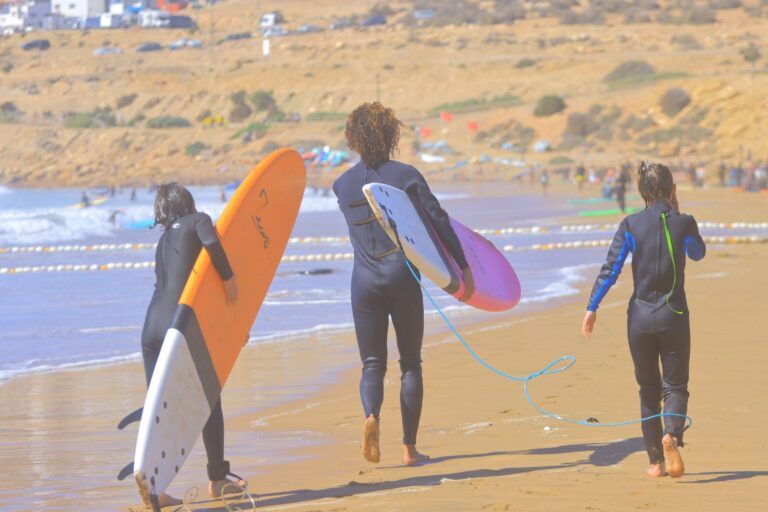
Small, warm summer surf at Panorama. The season most beginners are told to avoid is the one that suits them best.
Quick answer
Yes, there is surf in Taghazout in summer — but it is small. Expect 1–3 ft from June to September, water around 22°C, and the emptiest lineups of the year. The points mostly switch off; the sandy beaches at Panorama and Devil’s Rock work fine. Surf early — the onshore wind arrives late morning almost every day. Best season of the year for a first lesson; the wrong season if you came for Anchor Point.
The honest version first
Most pages about summer in Taghazout are written by people trying to sell you a July surf trip. Here is the version from someone who is in this water every week of the year.
From roughly June to September the North Atlantic goes quiet. The storms that generate our winter groundswell are not there. Some mornings the ocean is genuinely flat — glassy, beautiful, and completely unrideable at the points. If you are an advanced surfer coming specifically to surf Anchor Point at size, do not book July. Book November.
But if you have never surfed, summer is the best season of the year to come, and it is not close. Small, gentle, warm, uncrowded. Everything that makes winter thrilling for an experienced surfer makes it intimidating for a beginner, and summer strips all of that out.
What the ocean actually does, month by month
| Month | Typical surf | Water | What it suits |
|---|---|---|---|
| June | Small, 1–3 ft, occasional clean pulses | ~20°C | Beginners, improvers, longboarders |
| July | Smallest of the year, often 1–2 ft | ~21°C | First-timers, families, kids |
| August | Small and inconsistent, flat spells common | ~22°C, warmest | First-timers, families — and the quietest lineups |
| September | Small but the first autumn pulses arrive | ~22°C | Beginners, and improvers who get lucky |
Water temperatures are seasonal averages for this stretch of coast. Surf sizes are what we typically see, not a forecast. Checked August 2026.
The pattern that matters more than the numbers: mornings are clean and afternoons are not. Almost every summer day here follows the same shape — light or offshore wind at dawn, a thermal onshore breeze building from late morning, and a messy, choppy ocean by two in the afternoon.
This is why every one of our summer lessons runs early. It is not a scheduling preference, it is the difference between a good session and a bad one.
Which spots still work when it is small
When the swell is under 3 ft, most of the famous names switch off. The points need size to wrap around the headlands. What is left is the good news for beginners: the sand.
| Spot | Works in summer? | Why |
|---|---|---|
| Panorama | Yes — reliably | Sand bottom, gentle rights, exactly what a first lesson needs |
| Devil’s Rock | Yes | Beach break takes what little swell there is head-on |
| Banana Point | Yes — this is its season | Comes alive on 1–3 ft. Longboard heaven on a clean morning |
| Imsouane (The Bay) | Often | Long, slow and forgiving. Worth the 90-minute drive on a flat week |
| Hash Point | Rarely | Needs 4 ft+ to switch on. Usually soft and fat in summer |
| Anchor Point | Almost never | A winter wave. Do not plan a July trip around it |
| Killer Point | No | Needs 5 ft+. It will be flat |
If you already surf and the forecast is dead, the honest answer is that a guided day earns its money most in summer, not winter. In December almost everything is working and you can find a wave yourself. In August, finding the one corner that has something takes local knowledge.
Why summer is the beginner season
- The waves are your size. Learning in 2 ft of warm whitewater is a completely different experience from learning in winter 5 ft.
- The water is warmest. Around 22°C in August. A shorty is enough for most people, and cold is one less thing to fight.
- The lineups are empty. August is the quietest surf month of the year here. You get space to fall off without anyone watching or being in your way.
- Long days. Light from before 7am to after 8pm, so there is room for an early session and a second one at sunset.
- Accommodation is cheaper. Surf-season pricing runs October to April. Summer rates are noticeably lower.
If it is your first time on a board, start with a beginner surf lesson and read how long it actually takes to learn before you plan seven straight days of surfing.
The heat, and the thing nobody warns you about
Inland Morocco is brutal in midsummer — Marrakech regularly passes 40°C. Taghazout is not that. The Atlantic keeps the coast roughly ten degrees cooler, and there is almost always a sea breeze. Daytime here sits around 25–30°C.
What does catch people out is the sun on the water. Two hours of a surf lesson with the sun overhead and reflection off the surface will burn you in a way an afternoon on a beach lounger will not. Wear a rash vest or a shorty rather than going topless, and use reef-safe zinc on your face. We watch this happen to at least one person a week every summer.
The other one: drink more than you think. Bring water to the beach. We include a bottle with every lesson for exactly this reason.
Chergui — the desert wind
A few times each summer a hot easterly wind called the chergui blows off the Sahara. It pushes the temperature up sharply for a day or two and the air turns hazy and dry.
For surfing it is actually good news: an easterly is offshore here, so the ocean goes glassy and clean. For sitting on the beach it is unpleasant. If you land during a chergui, surf in the morning and spend the afternoon somewhere with shade — the Paradise Valley pools are the obvious answer, though check with us first because the water level drops through the summer.
What to do when it is genuinely flat
Some summer days there is simply no surf. Plan for it rather than being disappointed by it.
- Sandboarding on the Timlalin dunes — the dunes do not care about the swell, and the sunset trip is better in summer than winter.
- A beach ride at sunset, when the sand has cooled and the light is at its best.
- Imsouane — the one wave most likely to still be working. Ninety minutes north.
- Paradise Valley early — go in June rather than August if you want the pools full.
- Surfskate or a longboard session at Banana Point, which is at its best in exactly these conditions.
There is a full list in 15 things to do in Taghazout beyond surfing.
So should you come in summer?
Come in summer if: you have never surfed, you are bringing children, you want warm water and empty beaches, you are travelling on a budget, or you are combining surf with a wider Morocco trip.
Come in winter instead if: you already surf well and you are here for the points. October to March is when this coast does the thing it is famous for — see surfing Taghazout in winter and the month-by-month breakdown.
Most people who ask me this question are beginners who have been told winter is “the season” and are worried they are coming at the wrong time. If that is you: you are coming at the right time. The waves in August are small because the ocean is being kind to you.