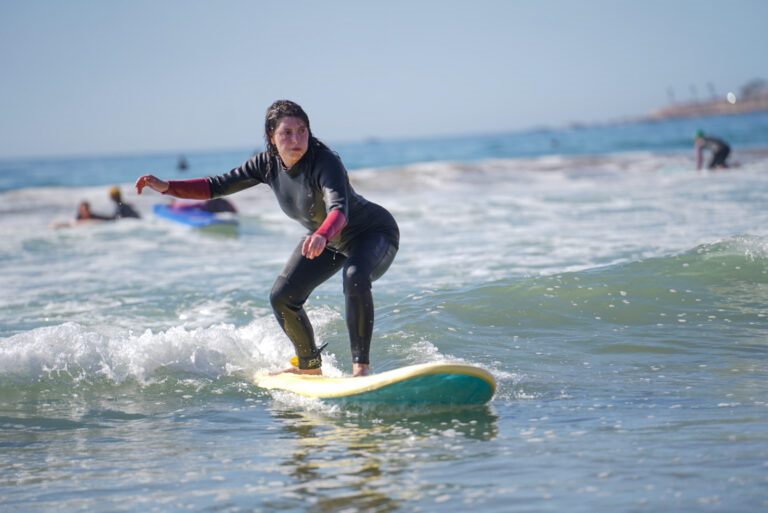
Point breaks concentrate everyone in one place. That is why etiquette matters here.
Quick answer
Taghazout is point breaks, so everyone sits in the same spot and priority goes to the surfer furthest up the point. Do not drop in, do not paddle through the lineup, take fewer waves than you want in your first session, and hold on to your board. Beginners should be on the sand at Panorama or Devil’s Rock, not at Hash Point.
Why etiquette matters more here than at home
Taghazout’s waves are point breaks. That means everyone sits in roughly the same place, waiting for a wave that peels from one spot, in one direction. A beach break spreads people out. A point break stacks them up.
Add a few hundred visiting surfers in December and a lineup of locals who surf it every single day, and the margin for cheerful ignorance gets thin. Nobody here is unfriendly. But turning up and taking waves you have not earned will make your trip worse, and it is entirely avoidable.
The rules that actually get enforced
- The surfer closest to the peak has priority. On a right-hand point that means whoever is furthest up the point. If they are paddling, it is theirs.
- Do not drop in. Taking off in front of someone already riding is the one thing that will genuinely annoy people. If you do it by accident, apologise. It happens.
- Do not paddle straight through the lineup. Paddle wide, around the back, even if it is slower. Paddling through the middle of the peak makes you an obstacle.
- Do not snake. Paddling around someone to claim priority is worse than dropping in, because it is deliberate.
- Wait your turn. Rotation is informal but real. If you have just had a wave, let others go.
- Hold on to your board. Ditching it in a crowded lineup is how people get hurt. If you cannot control it in these conditions, you are at the wrong spot.
Respecting the local lineup
There is a real difference between a wave that a hundred visitors surf and a wave that thirty locals have surfed since they were children. Anchor Point, Hash Point and Killers all belong to the second category.
The way in is simple and it works everywhere: sit slightly wider than you think you should, take fewer waves than you want in the first session, say hello in the water, and do not paddle for everything. Three days of that and you will be given waves rather than having to take them.
A word in Arabic or Tamazight goes a very long way too. Salam is enough.
Cameras, drones and photographing people
Drones over a crowded lineup are unpopular and in some spots genuinely resented. If you are filming, film your own group. Photographing local people, in the water or in the village, without asking is not acceptable here — ask first, and accept no as an answer.
If you are a beginner
Almost none of this applies to you yet, and that is the point. Beginners belong on the sand-bottomed beaches — Panorama and Devil’s Rock — not in a point-break lineup.
The single most common mistake visiting beginners make in Taghazout is paddling out at Hash Point because it is closest to the cafes. It is a rock-bottom wave with a resident crowd. Learn on sand, then move up.
Out of the water
Taghazout is a working Moroccan fishing village that happens to have surf, not a resort built around it. Dress modestly walking through the village — a rash vest or a t-shirt over your wetsuit is plenty. During Ramadan, do not eat, drink or smoke openly in the street during daylight. Take your litter home; the beach cleans itself far more slowly than the crowd fills it.